


Buying Guide
How to Buy Pull-Up Assistance Bands
This short guide helps you pick the right pull-up assistance bands fast. It covers what matters most, the main product types, the specs to check, where to buy, common mistakes to avoid, and quick expert tips to get results safely.
Key factors to consider
Resistance range and progression: choose a set that covers very low assistance up to heavy support so you can reduce assistance as you get stronger.
Material and safety: look for natural latex or heavy tubular rubber and protective fabric sleeves or covers to reduce snap risks.
Attachment and fit: pick bands with an adjustable strap or metal buckles for secure fit to different pull-up bars and clear length markings if you are short or tall.
Included accessories: useful extras are a durable foot or pedal support, a storage bag, a travel pouch, and a printed guide.
Price and warranty: expect sets around $25 to $40; check for clear warranty or return policy.
Material and safety: look for natural latex or heavy tubular rubber and protective fabric sleeves or covers to reduce snap risks.
Attachment and fit: pick bands with an adjustable strap or metal buckles for secure fit to different pull-up bars and clear length markings if you are short or tall.
Included accessories: useful extras are a durable foot or pedal support, a storage bag, a travel pouch, and a printed guide.
Price and warranty: expect sets around $25 to $40; check for clear warranty or return policy.


Types and categories
- Loop bands (flat or tubular): common, flexible, and easy to combine for more resistance.
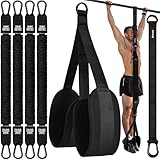
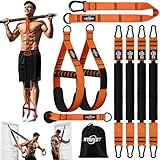
- Band sets with adjustable strap and foot pedal: better for stable foot positioning and quick height changes.
- Fabric-wrapped bands: tubing encased in nylon sleeve for longer life and improved safety.
- Single heavy-duty strap systems: fewer pieces, often adjustable length and higher combined resistance for advanced lifters.
Important features and specifications to check
Resistance labeling: verify pounds per band and the maximum combined resistance; typical single-band ranges go from about 5 lb up to 100+ lb and combined totals may reach 260 to 320 lb.
Band length: longer bands give more comfortable movement and fit taller users; some sets list lengths around 80 inches.
Hardware quality: metal buckles and double metal rings are more secure than cheap plastic fittings.
Foot support: a wide reinforced pedal or a well-padded foot strap improves comfort and reduces the chance of slippage.
Protective covering and build: fabric sleeves slow oxidation and extend life; multiple layers or thicker tubing last longer.
Allergy info: if you have latex sensitivity, check materials or look for latex-free alternatives.
Portability: a compact bag and lightweight bands are useful for travel and home use.
Band length: longer bands give more comfortable movement and fit taller users; some sets list lengths around 80 inches.
Hardware quality: metal buckles and double metal rings are more secure than cheap plastic fittings.
Foot support: a wide reinforced pedal or a well-padded foot strap improves comfort and reduces the chance of slippage.
Protective covering and build: fabric sleeves slow oxidation and extend life; multiple layers or thicker tubing last longer.
Allergy info: if you have latex sensitivity, check materials or look for latex-free alternatives.
Portability: a compact bag and lightweight bands are useful for travel and home use.

Where to buy, mistakes to avoid, and expert tips
Where to buy:
- Online: best for wide selection, customer reviews, and price comparisons. Read user photos and Q and A for real-world fit and durability notes.
- Retail stores: good if you want to inspect material, test strap hardware, and ask staff questions before buying.
- Picking resistance by color alone. Color codes vary by maker, so always check the lb rating.
- Buying only one band. A multi-band set gives progression and stacking options.
- Neglecting length and compatibility. Short straps or wrong mounting can make bands awkward or unsafe.
- Using damaged or dry-rotted bands. Replace any band with nicks, cracks, or fraying.
- Start with heavier assistance and reduce band help as reps improve. Track which band combinations you used so you can measure progress.
- Combine bands for small jumps in assistance rather than large jumps.
- Use a single wide foot pad if you want more stability; two narrow foot loops can move around more.
- Store bands away from direct sun and heat to extend life and inspect them before every session.
- If you are new to pull-ups, pair assisted sets with negatives and scapular engagement drills for faster strength gains.
Final Thoughts
Pick a set that gives a wide resistance range, solid attachment hardware, and protective covering. Buy where you can verify specs and returns, avoid choosing by color alone, and follow small progression steps. Proper selection and care will keep you safe and get you to unassisted pull-ups faster.