




Buying Guide
How to Buy a Level 2 Home EV Charger
This quick guide explains what matters when buying a Level 2 home EV charger so you can pick the right unit fast. It covers the key buying factors, the main product types, must-have specs, where to buy, common mistakes, and practical tips you can use right away.
Key factors to consider
Power and charging speed: Check the amperage and kW rating. Common options are 32A (about 7.7 kW), 40A (about 9.6 kW) and 48A (around 11.5 kW). Higher amps charge faster but need larger dedicated circuits.
Installation method: Decide plug-in versus hardwired. Plug-in units use a NEMA 14-50 outlet for easy setup. Hardwired units deliver higher current but require an electrician and a dedicated circuit sized to the charger (for example a 48A unit usually needs a 60A breaker and wiring).
Connector compatibility: All North American EVs use the J1772 connector. Tesla and some newer cars may need a separate adapter. Always confirm connector requirements before buying.
Safety and durability: Look for ETL or UL listings, FCC and other certifications, and a weatherproof rating (IP65 or IP66, NEMA 4). Built-in ground fault and leakage protection reduce the need for extra hardware.
Installation method: Decide plug-in versus hardwired. Plug-in units use a NEMA 14-50 outlet for easy setup. Hardwired units deliver higher current but require an electrician and a dedicated circuit sized to the charger (for example a 48A unit usually needs a 60A breaker and wiring).
Connector compatibility: All North American EVs use the J1772 connector. Tesla and some newer cars may need a separate adapter. Always confirm connector requirements before buying.
Safety and durability: Look for ETL or UL listings, FCC and other certifications, and a weatherproof rating (IP65 or IP66, NEMA 4). Built-in ground fault and leakage protection reduce the need for extra hardware.


Types and important specifications
Main types to pick from:
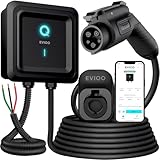
- Hardwired Level 2 chargers: Higher power options up to 48A for fastest home charging. Best for homeowners who want the quickest daily charging and are OK with professional installation.
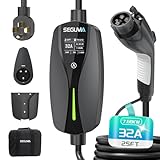
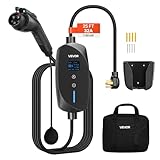
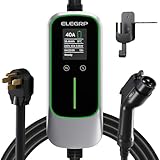
- Plug-in Level 2 chargers with NEMA 14-50: Portable, easy to install, commonly 32A or 40A. Great if you want DIY setup or need to move the unit between locations.
- Portable chargers with built-in controls and displays: Offer adjustable current, timers, and delay-start features for off-peak charging.
- Cable length: 20 to 25 feet is common and more convenient for awkward parking.
- Adjustable amperage: 1A steps or set presets let you match your home circuit and avoid tripping breakers.
- App and connectivity: 2.4 GHz Wi-Fi is typical. Check if the unit supports scheduling, energy tracking, and firmware updates.
- Operating range: Confirm temperature ratings if the charger will be outdoors (many support about -22°F to 122°F).
Where to buy and common mistakes to avoid
Online shopping benefits
- Wider selection and easier spec comparison.
- Access to product manuals, customer reviews, and faster price comparison.
- See build quality in person and ask store staff questions.
- Potential immediate pickup for urgent needs.
- Buying a charger without verifying your home circuit and breaker size. A 48A charger often requires a 60A breaker and 6 AWG wiring.
- Assuming any RV adapter will work. RV style adapters may not be suitable for EV charging; use the correct EV adapter if needed.
- Overlooking cable length and parking position which can make a perfectly capable charger unusable at your spot.
- Ignoring certification and weatherproof rating, or buying an app-enabled charger without checking the Wi-Fi band (many devices only support 2.4 GHz).

Expert tips and recommendations
If you want simple plug-and-play, choose a 40A plug-in unit and confirm you have a NEMA 14-50 outlet. If you need the fastest daily charging and plan long-term at one address, consider a hardwired higher-amp unit and budget for electrician costs.
Prioritize these features: adjustable current settings, at least 20 to 25 ft cable, ETL or UL certification, and a weatherproof rating of IP65 or higher. Choose a unit with scheduling and basic energy tracking to save on electricity cost.
Before checkout, confirm warranty length and customer support availability, save receipts for possible rebates or tax credits, and keep a Tesla adapter on hand if you own a Tesla. Expect typical price range from around $160 for basic plug-in units up to $430 for higher-power hardwired models.
Prioritize these features: adjustable current settings, at least 20 to 25 ft cable, ETL or UL certification, and a weatherproof rating of IP65 or higher. Choose a unit with scheduling and basic energy tracking to save on electricity cost.
Before checkout, confirm warranty length and customer support availability, save receipts for possible rebates or tax credits, and keep a Tesla adapter on hand if you own a Tesla. Expect typical price range from around $160 for basic plug-in units up to $430 for higher-power hardwired models.
Final Thoughts
Pick the charger that matches your home wiring and daily range needs first, then confirm cable length, certifications, and smart features. For most users a 40A plug-in hits the best balance of cost, speed, and ease of installation. If you want peak speed and plan to stay put, invest in a hardwired higher-amp unit and hire a licensed electrician.